News & Insights
AI Should Think With You, Not for You
June 23, 2026
The danger of AI in product development is that it makes work feel easier while quietly raising the stakes. Teams can move from brief to prototype in hours, but speed without the right oversight accelerates risk just as fast. When discovery gets skipped and briefs go unchallenged, design and product teams can now be wrong at speed and at scale.
The teams accomplishing the most with AI right now share three things: they understand what they are building and for whom before jumping to solutions, build in accountability from the start, and validate with real users early.
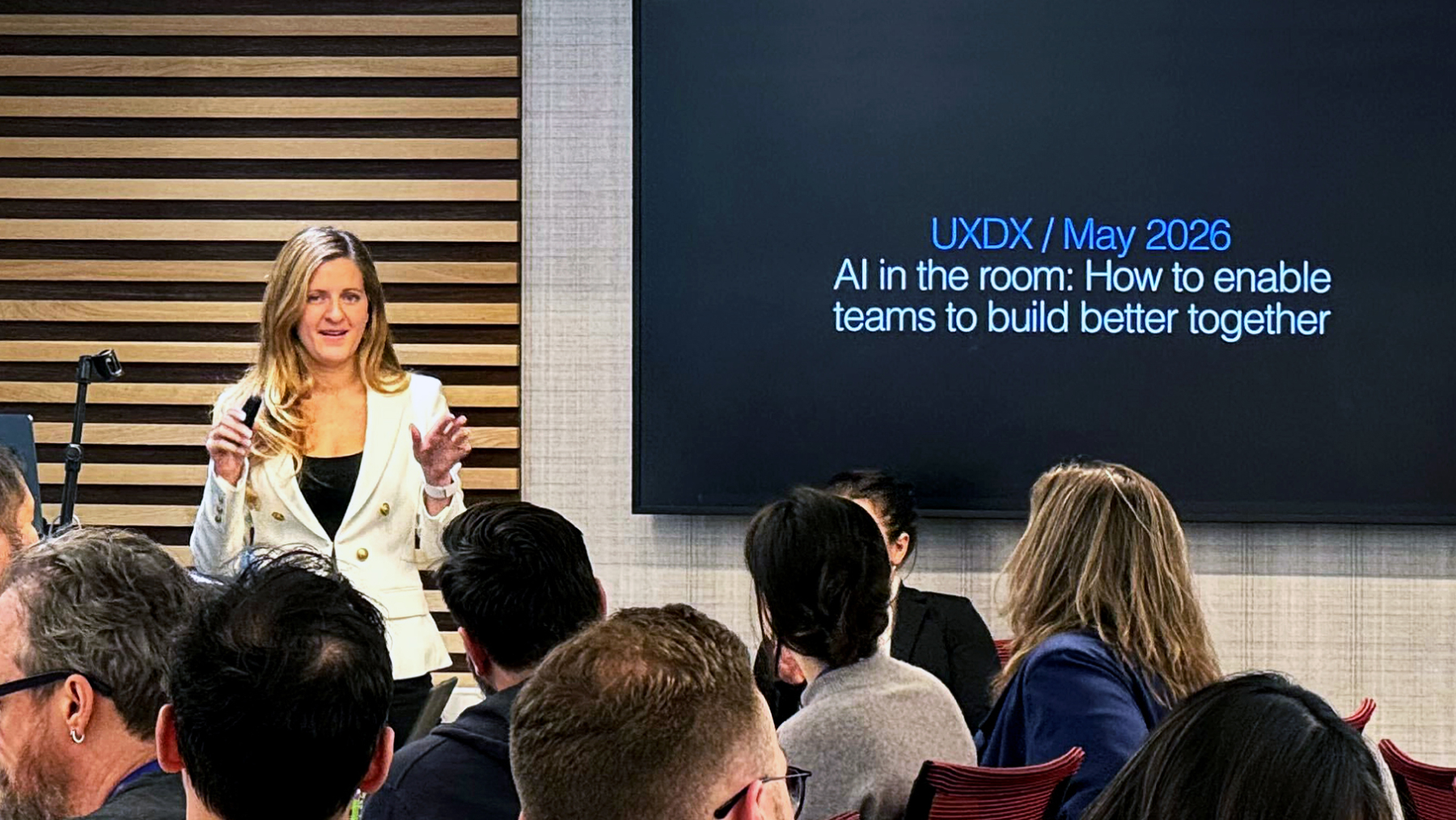
These are the principles Christina Kalsow-Ramos, Group Director of Product Management at Work & Co, brought to practitioners at UXDX USA 2026 in New York, where she led a workshop on how product, design, and engineering teams can build better together with AI in the room.
The brief is your starting point, not your answer
Most teams receive a brief. It arrives with scope, constraints, a proposed solution, and a set of assumptions baked in. The brief is not the answer, it is the starting point for discovery, where you find out what users actually want and why they want it. At the end of discovery, the whole team should be able to answer two questions: what problem are we solving, and for whom. If the room cannot agree on those two answers, you are not ready to build.
This sounds obvious. But right now I see a lot of teams jumping straight to AI-generated solutions before they have understood the customer’s needs. A feature gets prescribed in the brief and because AI can produce a prototype in hours, the question of whether that is the right solution never gets asked. The assumptions in a brief do not disappear when AI enters the picture. If anything, they become harder to catch because the speed of execution removes the moments where someone might have questioned them.
This is where AI genuinely helps. It changes what is economically viable to do before you commit. Thousands of support tickets synthesized into themes in an afternoon rather than three weeks. Interview questions generated from a brief in minutes, then reviewed and edited by a human who removes the leading ones and adds the follow-up questions that only intuition catches. On every project, we come back to the same approach.
Start by giving AI the right context and naming your assumptions before you ask it anything. The quality of what AI surfaces is directly proportional to the quality of what you bring to it. Then challenge actively by asking for opposing views and always asking what is missing. AI is a capable devil’s advocate that will surface the assumptions your brief is making and the questions that undermine the solution you have already fallen in love with. And keep humans in the lead throughout, because a human has to decide which clusters of feedback represent a real product problem versus a user education problem. AI works best as a thinking partner, not a decision maker.
Responsible AI as a founding principle
The responsible AI pillars (transparency, fairness, accountability, safety, privacy, human oversight) are not a checklist you complete before launch. They are fundamental principles for how humans and AI share accountability throughout the product lifecycle.
Three things AI does that make human oversight non-negotiable:
- AI can be confidently wrong. It does not hedge. It presents a hallucination with the same tone as it presents a fact. Your team needs to build workflows that account for it.
- AI inherits bias. Whatever bias exists in the training data exists in the model. You will not always be able to see it, which means you have to build for it, in your testing, in your review processes, in who you put in the loop before something ships.
- AI cannot understand consequences. It can produce an output. It cannot weigh the downstream impact of that output on a real person in a real context. That weight belongs to humans.
For Gatorade, responsible implementation was not one decision. It was a stack of decisions, each one covering the gaps the last one left open. We built on Adobe Firefly, trained on licensed content with IP indemnification. We implemented a safety workflow on top of the model. We staffed a human moderation layer reviewing generations in real time. And every single order was reviewed by a human before it shipped.
That last point matters: no matter how well you design your safeguards, you cannot automate your way to full confidence. Humans in the lead is a workflow requirement, not just a principle.
When you think about responsible AI as something you plan for from the beginning rather than address at the end, the whole character of the product changes. It shows up in how you train, what you test, who you keep in the loop, and how you design for the users who are least like you.
Nothing replaces validation from real users
With AI products especially, by the time you get to testing, you have made hundreds of decisions that are expensive to undo. You have to validate as you design and build, not as a checkpoint, but as a habit.
Real users are irreplaceable for three reasons. Depth and empathy, lived experience and context that no simulation can replicate. The gap between online behavior and real behavior, where the people most motivated to leave a review are usually those who had a bad experience, which means designing from that data alone means solving for an outlier, not an average. And nonverbal signals, the hesitation, the furrowed brow, the moment someone says “yeah this is fine” while their face says something completely different. Those signals only exist in a real conversation, and they are often where your most important insights are hiding.
What AI has changed is how quickly you can get something real in front of a real person. That changes when you test, not at the end, but continuously. Use that speed to get to real users sooner. The teams that do that fastest are the ones that find out what is true before it becomes too expensive to change.
AI changes the pace, not the fundamentals
The hallmarks of a great product have not changed. What has changed is how quickly you can get there, and how quickly you can get it wrong. The teams building the best products with AI are the ones using it to think harder, not to think less. They know what they are building and for whom, build in accountability from the start, and get real product in front of real people as early as possible.
About the author
Christina Kalsow-Ramos is a Group Director of Product Management at Work & Co, part of Accenture Song. With more than a decade of expertise in creating award-winning products, platforms, and digital experiences, Christina has been entrusted by clients such as PepsiCo, T-Mobile, Google, Trading.com, and ALDO to create new and reimagined interfaces.
Stay informed
Get occasional updates about our digital products, news, and events.