News & Insights
Q&A with Pfizer Innovation Leader Cozi Namer
July 23, 2026
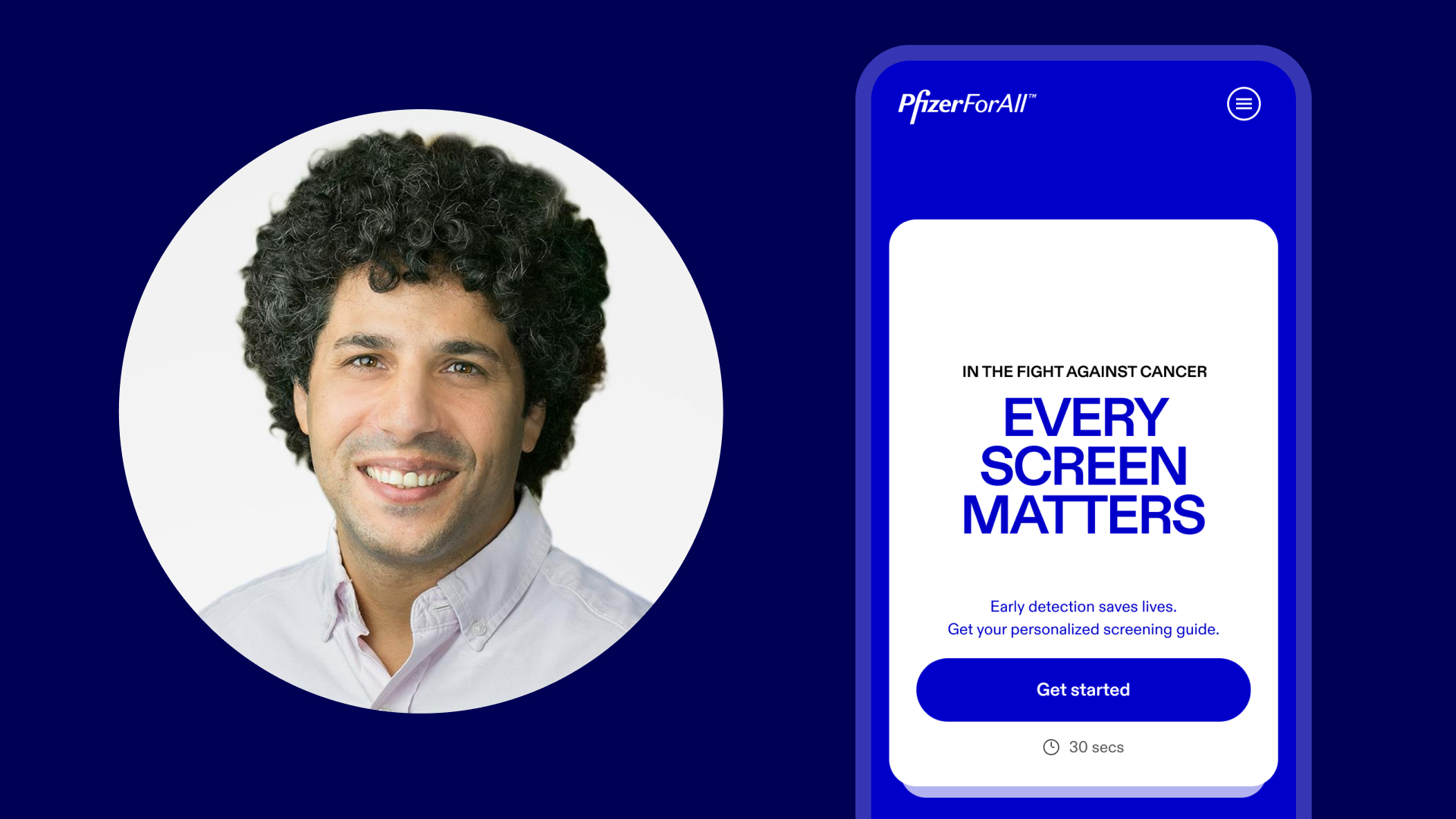
Cozi Namer has spent more than 20 years at the intersection of digital and healthcare. Before joining Pfizer in 2023 as VP of Consumer and Clinician Innovation, he spent over a decade at Google, including leadership roles in Google Health and Google AI and core product areas touching Healthcare. His instinct has always been to bring the standards that define the best consumer digital experiences into healthcare, where the stakes are higher, and friction has historically been greater.
His team’s recent work, the PfizerForAll Digital Cancer Screening Guide, created in collaboration with Work & Co, reflects that approach. Building on Pfizer’s longstanding partnership with the American Cancer Society, whose foundational work in cancer screening set the standard, the team layered in modern UX thinking to take what was already best-in-class and make it go further. The goal was to make something that felt native to how people actually move through digital products today, not how healthcare has traditionally asked them to.
Here, Cozi shares the design philosophy behind the experience, how it can help people take action and get screened for cancer, and why a few minutes on the PfizerForAll Digital Cancer Screening Guide could be one of the most important things someone does for their health.
Work & Co
Why is Pfizer so focused on empowering people to screen for cancer — and why does digital feel like the right lever to pull?
Cozi Namer
Prevention has always been core to Pfizer’s heritage, whether that’s through vaccines or our longstanding belief in helping people stay well versus just treating illness. One in three people will face a cancer diagnosis in their lifetime. But for many cancers, early detection can change the entire course of a person’s journey and save lives. That’s why screening is so impactful and why making it easier to access is so important.
The challenge, though, is making the screening process easier to understand and each person’s next step feel doable. A well-designed digital experience is the right lever because it meets people where they already are and helps address barriers like the uncertainty of what screenings may be right for them and the friction of scheduling. That’s the mission behind the PfizerForAll Digital Cancer Screening Guide.
Work & Co
What are the design choices that are critical and non-negotiable in healthcare — and how does that differ from other industries?
Cozi Namer
The core principle is simple: get out of the way and give people agency. That means only asking for what we genuinely need to give you the most relevant, actionable guidance. Every question has a purpose, making your recommendation more personal and your next step clearer. If it doesn’t do that, it has no place in the experience. Other industries have figured out how to make their experiences frictionless, but healthcare is still evolving.
Unfortunately, the healthcare industry has a tendency to overcomplicate things and make the path harder than it needs to be. To do the opposite and make sure every step feels clearer, easier, and less intimidating, we built the cancer screening guide around three principles: clarity over complexity, momentum over overwhelm, and confidence over fear.
Simplicity and clarity matter deeply. So does continuous education. Even people who didn’t complete the assessment were exposed to useful information along the way. We also paid close attention to the reading level throughout. While most health content defaults to medical or legal language, we worked hard to use plain, everyday terms to make the experience accessible to everyone.
Work & Co
How does the platform help people move from awareness to actually getting screened?
Cozi Namer
We’re seeing strong completion rates on the assessment, upward of 75%, and that’s our biggest achievement. We got there by prioritizing high-value actions through prototyping and user testing, guided by one straightforward question: after the five-question quiz, what next step are people most likely to take? We answered that through multiple rounds of research without tracking individual responses.
We also made deliberate choices about where we sent people next. Rather than pointing users to a generic provider finder, we chose platforms people already know and trust, either for booking healthcare appointments or for at-home test delivery. The goal was to make the next action feel as easy and familiar as possible.
The campaign also helped connect the message to action. Through third-party measurement, we’re seeing evidence that media exposure influenced hundreds of thousands of screenings, even before many people came to the platform.
Work & Co
Now that the platform has been live for several months, what are you learning — and how does the launch of new at-home testing options fit into that?
Cozi Namer
In healthcare, change takes time, and systems remain complicated. Closing that last mile is the real challenge, while also respecting the regulations of our industry. So, I’d say there’s more work to do on trust-building and awareness.
We’re also eager to see more people seeking out the guide on their own, rather than learning about it through paid media or other channels. We know the assessment works, so the question now is how to deepen the relationship over time and close the gap between quiz completion and action.
That’s also why at-home testing matters. Recently, we’ve introduced ways to point people toward options for cervical and prostate cancer screening, so they can take the next step from home. The goal is to get people from “I should get screened” to “I’ve scheduled my screening” with as little friction as possible.
Work & Co
If someone reading this has never visited the PfizerForAll Digital Cancer Screening Guide — what would you want them to know before they do, and what do you hope they’ll do after?
Cozi Namer
It’s simpler than you may think: five questions, plain language, no medical jargon. By the end, you’ll know which screenings are recommended for you based on your age, background, and circumstances.
Most people aren’t getting screened because they don’t know where to start. That’s what this guide is for. You spent a couple of minutes reading this, so spend much less time on your health. Find out which screenings may be right for you and take that next step: speak to your doctor, book the appointment or order an at-home test. And if this resonates, share it with someone you love.
Stay informed
Get occasional updates about our digital products, news, and events.